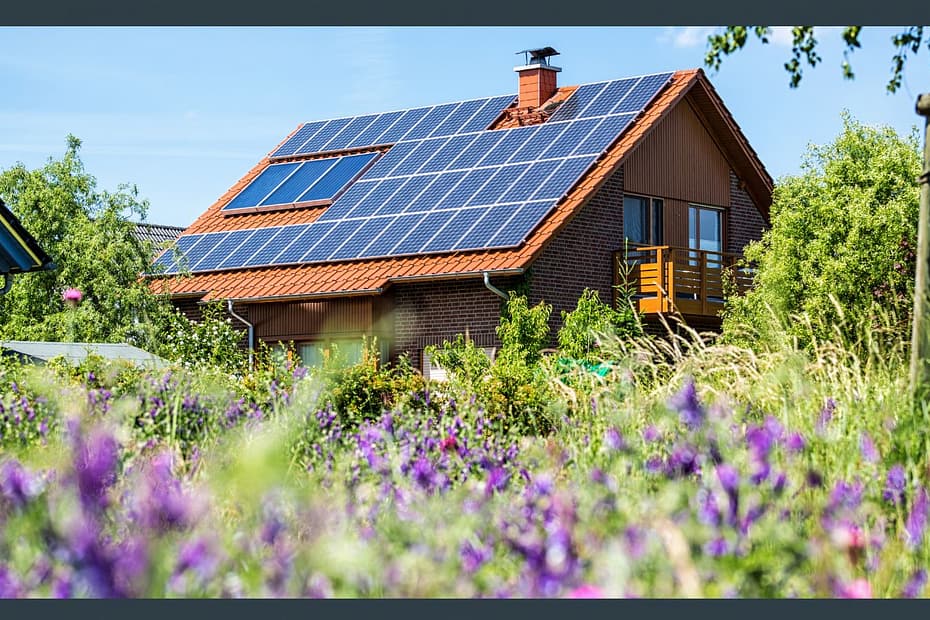
Introduction: Energy Independence Starts Here
This post introduces off-grid solar systems. It is meant for beginners who know nothing about solar power. Whether you want to power your cabin, RV, or boat, this post explains the basics of how the systems work. Once you understand the basics, you can better evaluate and process the endless choices and details available online. Future posts will go into detail on the various sub-topics.
In short, an off-grid solar system allows you to collect, use, and store electricity so you have power whether the sun is shining or not. The system does this without being connected to the electrical grid.
To have electricity without a grid connection, you need solar panels, a charge controller, an inverter, and a battery. Let’s learn more about the individual components.
Main Components of an Off-Grid Solar System
Solar Panels
First and foremost, Solar panels capture sunlight and convert it into direct current (DC) electricity. The panel’s rated watts refer to its maximum output under full sunlight. A typical 200-watt panel is about 30″ wide x 60″ long and weighs about 25 pounds. A 400-watt panel is about 45″ wide x 75″ long and weighs about 50 pounds. Solar panel life is measured by how many years it will run until it produces only 80% of its capacity when new.
There are multiple ways to describe the size of a solar energy system, for example, in kilowatts (kW). For a small cabin 5kW system, you will need either 25 200-watt panels or 12 450-watt panels (actually 4.8kW).
Kilowatt-hours (kWh) are another important measure of a solar energy system. A 5kW solar panel array will produce 25 kWh of energy with 5 hours of midday sunlight.
Solar Energy Math
It is important to understand the math of solar energy.
1000 watts = 1 kilowatt
The math for kilowatts and kilowatt-hours is: 5kW x 5 hours of sun = 25 kWh of energy.
A 100-watt light bulb burned for 4 hours: 100 watts × 4 hours = 400 Wh = 0.4kWh.
Batteries store electricity in kWh. We will go over solar energy math and system sizing in more detail later.
Battery Storage
Batteries store the energy generated by solar panels. The batteries can provide power when the sun is not shining and on cloudy days.
When sizing your battery pack, consider how much energy you use in a day and how many cloudy days you want to have power before you have to turn on a backup generator. You also need to make sure your batteries can supply the peak current you need to start and run your largest appliances.
To summarize, your batteries must have enough power (watts) to start and run your largest appliance, and they must also store enough energy (watt-hours) to cover the hours or days when there is no solar energy input. You can learn more about solar storage batteries here. best solar battery
Inverter and Charge Controller
Your off-grid system needs two additional critical components:
Solar Charge Controller
The solar charge controller is the voltage and current regulator between your solar panels and batteries. The voltage and current produced by the solar panels vary with the amount of available sunlight. The charge controller accepts electrical power and adjusts it to a voltage and current suitable for charging the batteries. The charge controller also protects the batteries from being overcharged.
Different types of batteries require different charging profiles. High-quality controllers are programmable for the batteries you use.
There are two main types of charge controllers—MPPT (Maximum Power Point Tracking) and PWM (Pulse Width Modulation). MPPT controllers are much more efficient and adjustable, while PWM controllers are simpler and more robust. PWM controllers are better for unattended, outdoor, small systems where there is plenty of sunshine.
MPPT controllers are better suited to larger systems that operate under varied conditions. For an in-depth comparison, see The Best Charge Controller.
Inverter
The inverter converts the direct current (DC) electricity produced by solar panels and stored in batteries into alternating current (AC) electricity to power your household appliances. Standard household electricity is AC. If you will run sensitive electronics with your inverter, make sure it produces a pure sine wave AC current. Some basic inverters produce “dirty” AC that can damage some appliances.
How Off-Grid Solar Systems Work Step by Step
Understanding the operational flow helps clarify why system design is critical. Here’s how a complete off-grid solar system operates throughout a daily cycle:
Daytime Operation (Solar Production Peak)
Step 1: Solar Generation
Solar panels absorb sunlight and generate DC electricity proportional to the intensity of sunlight. During the day, the solar panels generate excess power, allowing you to run your appliances and charge the battery. On a clear day, a 5kW solar array produces maximum power around midday for about 5 hours, depending on the location. For example, you get more out of your solar panels per day in Florida than in Maine.
Step 2: Charge Controller Regulation
The charge controller receives solar-generated electricity and adjusts the voltage and current to match the battery’s needs. It monitors battery voltage and adjusts charging parameters to prevent overcharging while maximizing charge rate during peak sun hours.
Step 3: Battery Charging & Simultaneous Consumption
During midday, when the solar panels are generating the most electricity, the system runs your appliances and charges the batteries simultaneously.
Evening and Nighttime Operation
Step 5: Battery Discharge Begins
As the sun sets and solar production drops to zero, your batteries automatically begin discharging to power your home. The inverter converts DC power from batteries into AC power for your appliances.
Step 6: Night-Long Power Supply
Throughout the night, batteries steadily discharge, providing all household power needs.
Your battery bank must be sized to store enough energy to power your home throughout the entire nighttime period, and to account for cloudy days when solar production is reduced.
Many off-grid systems are sized to run on batteries for 2 or three days in case of cloudy weather. A gas- or diesel-powered generator is handy for backup power and for charging batteries if bad weather persists.
If the grid is available in your area, you can also use it as a backup source of power.
Multi-Day and Seasonal Cycles
Step 7: Backup Generator Engagement
If batteries deplete beyond safe levels (typically 50% state of charge for lead-acid batteries, 5-10% for lithium), the backup generator automatically starts. This prevents complete battery discharge, which would damage the system and leave you without power.
Step 8: Seasonal Adjustment
Over months and seasons, your off-grid system continuously adjusts to changing solar conditions. Winter generates less solar power due to lower sun angles and shorter days, so batteries discharge more deeply during winter months. Conversely, summer produces abundant power, allowing full battery charging with excess generation often unused.
Some off-grid systems are designed to use a fuel generator during the winter. This allows for fewer solar panels, smaller batteries, and overall, lower cost.
—
Off-Grid vs Grid-Tied Solar Systems 🏘️
Understanding the distinction between off-grid and grid-tied solar helps clarify whether off-grid is appropriate for your situation.
Key Differences Between Off-Grid and Grid-Tied Solar
Grid-Tied Solar: Connected to utility infrastructure, these systems feed excess power back to the grid (earning credits through net metering). When your panels don’t generate enough power, you automatically draw from the grid. This approach requires no batteries and minimal backup systems.
Off-Grid Solar: Completely independent, operating without a utility connection. Your system must generate sufficient power for all your needs and store excess in batteries. When batteries run low, backup generators activate.
Which System Is Right for Your Situation?
Choose grid-tied solar if:
- Your property connects to a reliable utility service
- You want maximum financial returns through net metering credits
- You prefer minimal maintenance and storage costs
- You want the simplest renewable energy solution
Choose off-grid solar if:
- Your property is remote and lacks utility access
- You seek complete energy independence
- You live in an area with unreliable power service
- You’re willing to manage a more complex system for autonomy
—
How Much Power Can an Off-Grid Solar System Produce? ⚡
The power output of your off-grid system depends on several factors, including panel size, location, weather conditions, and seasonal variations.
Daily Power Production Estimates
A typical 5kW off-grid solar array produces approximately:
- Summer day: 25-35 kWh under optimal conditions
- Winter day: 10-15 kWh due to lower sun angles and shorter daylight
- Cloudy day: 5-10 kWh regardless of season
- Seasonal average: 15-20 kWh per day (location-dependent)
Factors Affecting Power Production
Geographic location significantly impacts output. A system in Arizona produces substantially more than an identical system in Maine due to higher average solar irradiance. Similarly, altitude matters—higher elevations receive more direct solar radiation with less atmospheric interference.
Seasonal variations are unavoidable. Notably, winter production in northern latitudes can drop 70% compared to summer peaks. This reality drives battery sizing requirements, as your system must store enough summer surplus to sustain winter shortfalls.
Weather patterns affect daily output. Cloudy regions require larger solar arrays and battery banks than consistently sunny areas to achieve equivalent power availability.
Panel orientation and tilt angle optimize capture. Panels facing true south (in the northern hemisphere) and tilted at latitude-appropriate angles maximize annual production.
—
Is an Off-Grid Solar System Right for You? 🤔
Not everyone benefits from off-grid solar. This decision requires honest evaluation of your situation, priorities, and resources.
Ideal Candidates for Off-Grid Solar
Off-grid solar makes exceptional sense if you:
- Live on remote property without utility access or face high grid connection costs
- Value energy independence and want freedom from utility rate increases
- Have reliable sunlight in your geographic location
- Can afford upfront costs ($15,000-$50,000+ for complete systems)
- Are willing to manage energy consumption and system maintenance
- Need reliable backup power for emergency preparedness
- Enjoy an off-grid lifestyle or live in an RV/cabin full-time
When Off-Grid Solar Isn’t Ideal
Conversely, reconsider off-grid solar if you:
- Have access to reliable, affordable utility power with reasonable rates
- Cannot afford substantial upfront investment in batteries and equipment
- Live in consistently cloudy climates where solar production is marginal
- Want minimal system management and prefer “set it and forget it” simplicity
- Require absolute guarantee of uninterrupted power without backup generators
- Prefer maximizing financial returns through net metering credits
Assessment Questions
Ask yourself these critical questions:
- Do I have reliable sun exposure? Is my property shaded by trees, buildings, or geographic features that limit solar access?
- What’s my energy consumption? Can I reduce consumption through efficiency, or do I demand high power for air conditioning, heating, or industrial equipment?
- Am I prepared for maintenance? Off-grid systems require periodic monitoring, battery maintenance, and occasional repairs—can you handle this?
- What’s my backup power comfort level? Are you comfortable with a generator running occasionally during extended cloudy periods, or do you demand absolute silence?
- How long will I stay at this location? Off-grid systems represent long-term investments; short-term occupation rarely justifies the expense.
—
Understanding Off-Grid Solar System Costs 💰
Cost represents the primary barrier to off-grid solar adoption. Understanding the breakdown helps evaluate whether the investment aligns with your budget and goals.
Average Cost of an Off-Grid Solar System
Off-grid system costs vary dramatically based on size, location, and component quality. Notably, battery storage costs dominate total expenses, often accounting for 40-60% of the system cost.
Cost ranges by system type:
- Small systems (3-5kW): $12,000-$25,000
– Suitable for remote cabins, RVs with modest power needs
– 200-400 amp-hours battery storage
– Solar array: 3,000-5,000 watts
- Medium systems (8-12kW): $30,000-$60,000
– Suitable for full homes with moderate consumption
– 400-800 amp-hours battery storage
– Solar array: 8,000-12,000 watts
- Full-home systems (15-25kW): $75,000-$150,000+
– Suitable for homes with high consumption
– 800-1,600+ amp-hours battery storage
– Solar array: 15,000-25,000 watts or more
More detailed pricing information and component-by-component breakdowns are coming in a future post.
What Affects Off-Grid Solar System Cost?
Several variables significantly impact your total investment:
Battery technology choice dramatically affects cost. Lithium batteries cost 2-3x more than lead-acid batteries upfront, but offer a superior lifespan, greater depth-of-discharge capability, and better maintenance characteristics. Over 20+ years, lithium often provides better value despite higher initial cost.
Inverter capacity determines installation cost. Larger inverters (8kW-15kW) cost substantially more than smaller units (3kW-5kW), though you only need capacity matching your peak simultaneous loads.
Installation approach influences expenses. Professional installation costs $3,000-$10,000+ depending on complexity, while DIY installation saves labor but requires technical knowledge and carries safety risks.
Geographic location affects pricing through labor costs, shipping, and local permitting requirements. Remote areas often face higher costs due to travel expenses and limited local expertise.
—
Battery Types and Selection 🔋
Batteries represent the most critical and expensive component of off-grid systems. Understanding your options enables better decision-making.
Types of Off-Grid Solar Batteries
Lead-Acid Batteries: Traditional flooded, AGM, or gel battery types have powered off-grid systems for decades. They’re affordable ($150-$300 per kWh), familiar to installers, and proven reliable.
However, lead-acid batteries have limitations: a shorter lifespan (5-10 years), a lower depth-of-discharge capability (typically 50% safe discharge), and more frequent maintenance requirements.
Lithium Batteries (LiFePO4): Modern lithium iron phosphate batteries dominate emerging off-grid installations. They cost substantially more ($500-$1,000+ per kWh) but deliver superior performance: 10-15 year lifespan, 80-95% usable capacity, minimal maintenance, and higher efficiency.
For comprehensive battery comparison and selection guidance, see [Off-Grid Solar Batteries: Types, Costs, and Lifespan].
—
System Sizing Fundamentals 📐
Proper system sizing is critical—undersized systems fail to meet your needs, while oversized systems waste money on excess capacity you’ll never use.
Three Key Sizing Calculations
Daily energy consumption: Measure your daily power use in kilowatt-hours (kWh). This determines the size of your solar array and your battery storage requirements.
Solar array size: Calculate based on daily consumption, your location’s solar irradiance, and seasonal variations. Northern climates typically require larger arrays than southern locations.
Battery bank capacity: Size based on your desired days of autonomy (typically 3-7 days) multiplied by daily consumption. This ensures survival through extended cloudy periods.
Detailed sizing methodology and calculations are coming in a future post.
Making Your Decision: Next Steps 🚀
If you’ve reached this point and off-grid solar resonates with your lifestyle and goals, what’s next?
Take These Action Steps
1. Assess your solar resource: Research your location’s average daily solar irradiance using resources like PVWATTS or NREL data. This determines whether off-grid solar is feasible for your area.
2. Reduce energy consumption: Before sizing a system, implement energy efficiency improvements. LED lighting, efficient appliances, and smart power management significantly reduce the required system size.
3. Get a professional assessment: Consider hiring a solar professional to evaluate your property’s solar potential, shading issues, and optimal system design.
4. Compare costs and components: Research battery options, inverter models, and solar panel choices. Different manufacturers offer varying value and reliability.
5. Start with education: Continue learning through comprehensive resources. Acima Solar provides detailed guides on every aspect of off-grid solar systems, from component selection to maintenance.
—
Conclusion: Your Path to Energy Independence
An off-grid solar system represents more than a power generation method—it’s a pathway toward energy independence, self-sufficiency, and freedom from utility constraints. Whether you’re preparing for emergencies, seeking sustainable living, or simply tired of rising electricity bills, off-grid solar offers viable solutions.
However, success requires an honest assessment of your situation, adequate financial preparation, realistic expectations for system management, and a commitment to the long-term investment. The systems that perform best belong to users who understand their components, actively manage energy consumption, and embrace the responsibility of self-sufficient power generation.
The good news? You’re already taking the right first step by educating yourself. As you continue learning about off-grid solar systems, you’ll encounter detailed guides covering every aspect: costs, batteries, system sizing, DIY installation considerations, and real-world applications for cabins, RVs, and remote homes.
Ready to dive deeper? Explore Acima Solar’s comprehensive guides on off-grid solar fundamentals, component selection, cost breakdowns, and practical implementation. Whether you’re curious about system costs, comparing battery technologies, or evaluating whether off-grid living suits your goals, you’ll find accessible, detailed information designed to empower your decision-making.
Your journey toward energy independence starts with understanding how off-grid solar systems work. You’ve begun that journey here. Continue forward with curiosity, thorough research, and the resources available through Acima Solar—your trusted platform for practical, unbiased solar education.
Start exploring today, and take control of your energy future. 🌞